I’m listening to The Rise of the Novel from The Great Courses—a fascinating journey through a genre we take for granted today, yet which wasn’t always part of our cultural landscape.
Many scholars agree that the first true novel was Don Quixote by Miguel de Cervantes. I had known this for a while, but never really explored why—or what that meant at the time. In this course, professor Leo Damrosch, an expert in literature, guides us through these questions with a rare clarity. He reminds us to approach them from a distance, aware that we belong to a different culture and time. We inevitably bring our own lens to the discussion, yet must also imagine how the people of that era understood these issues.
In Lecture 3, Don Quixote and the Picaresque Novel, Damrosch closes with two powerful ideas. The first concerns the problems of translation, illustrated with two brilliant metaphors:
People fluent in Spanish tell us there’s a constant interplay between levels of language in this novel: courtly, romantic, colloquial, and so on. One critic says many of the linguistic effects are hilariously funny because Cervantes had an uncanny ear for the variations of the Spanish language, according to social class and region. Translators have to try to find equivalents for those in English, but obviously they could never be the same. When Don Quixote visits a printing shop, he says that reading a translation is like looking at a tapestry on the wrong side. A modern writer said it’s like kissing through a handkerchief.
I’ve always felt that much is lost in translation, yet often it’s all we have. In the past, many intellectuals learned Latin, Greek, and French—besides their native tongue—precisely to read the classics in the original.
Today, most readers master only the current lingua franca, English, alongside their mother tongue. Few go beyond to Latin or Greek. Even I, a native Spanish speaker, struggle with the Quixote’s 17th-century Spanish.
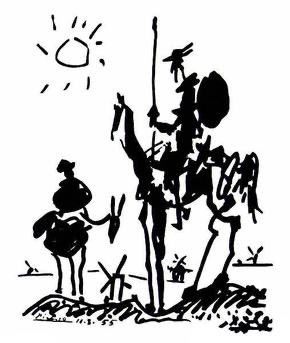
The second idea—about the human condition—is my favorite so far. It captures the inner tension we all carry: are we Don Quixote or Sancho Panza? The answer is both.
Beyond these obvious contrasts, Quixote and Sancho embody a permanent duality of human experience: spirit and flesh, courage and cowardice, and so on. That pairing has been echoed thousands of times. In this course alone, we will see it in Fielding, Anster, and Diderot. George Orwell gave a memorable formulation: Two principles—Noble Folly and base wisdom—exist side by side in nearly every human being. If you look into your own mind, which are you: Don Quixote or Sancho Panza? Almost certainly, you are both. There is one part of you that wishes to be a hero or a saint, but another part of you is a little fat man who sees very clearly the advantages of staying alive with a whole skin. He is your unofficial self, the voice of the belly protesting against the soul. It’s simply a lie to say he’s not part of you. It’s a lie to say Don Quixote is not part of you either. So the novel that began as a simple parody of a popular literary form ended by creating a universal archetype of human experience.
And just like that, the modern novel was born. As some authors have said, everything after Don Quixote is, in some way, a retelling of it. But perhaps that is not the whole truth. For when literature is faithful to what we hold within—when it unveils what we truly are—it transcends centuries, yet feels as if it were written for this very moment. The words may come from another age, but they speak in the voice of our own heart.