“Why aren’t you doing important work?”
— Richard Hamming
There is a quote by Søren Kierkegaard that goes something like this: life is understood backwards, but it must be lived forwards.
I never fully decided to become a researcher, or an academic for that matter. It simply happened. Yet when I look back on what has now been most of my professional life, it is difficult to imagine things unfolding any other way.
This week I came across a tweet summarizing a famous lecture by Richard Hamming, later published as You and Your Research. In it, Hamming reflects on his years at Bell Labs and on a question he liked to ask himself during what he called his “Great Thoughts Time.” Every Friday afternoon, he would step away from meetings, experiments, and deadlines to ask two simple questions:
What are the most important problems in my field?
And why am I not working on them?
The story is compelling, although perhaps too neat. Hamming’s account was not a formal study but a collection of observations gathered over decades. The world is more subtle than a division between researchers who change history and those who do not. Careers are shaped by opportunity, timing, funding, collaboration, luck, and countless other factors.
Still, there is something valuable in his question.
I often remember a conversation I had as an undergraduate with a professor I admired. He told me that his true love was quantum mechanics. Yet grants were difficult to secure for the questions that most fascinated him. So he wrote proposals on SARS viruses, computational drug design, and other applied topics. Those projects funded a research group, equipped a laboratory, and gave him enough room to pursue the work he truly cared about.
I have always liked that approach. Sometimes you need to put food in your belly so that you can feed the spirit.
When I look back on nearly twenty years of research, I do see a story. Not a straight line, but a story nonetheless. And I think I have generally tried to work on problems that mattered, at least within the constraints of time, resources, and circumstance.
Like John Tukey, who once described himself as a statistician with the privilege of playing in everybody’s backyard, I have enjoyed wandering across disciplinary boundaries. Through optics, imaging, signal processing, computer vision, and applied artificial intelligence, I have had the opportunity to collaborate on problems as diverse as materials science, remote sensing, dimensional metrology, and medical diagnosis.
Finding important problems is not easy. Before you can solve them, you first need to recognize them. That usually requires spending enough time inside a field to understand what people struggle with, what assumptions everyone takes for granted, and where the unanswered questions lie.
During my PhD, I spent years working on medical imaging in ophthalmology. At the time it was a relatively narrow area, but one with enormous potential impact. Together with several colleagues, I worked on improving image quality by framing the problem as an inverse problem. We published a number of papers that are still cited today.
Were those papers the peak of my scientific career? Were they truly important?
I honestly do not know.
What I do know is that they opened doors. They allowed me to continue exploring medical problems as an engineer and applied scientist, moving between disciplines while carrying the same toolbox from one domain to another.
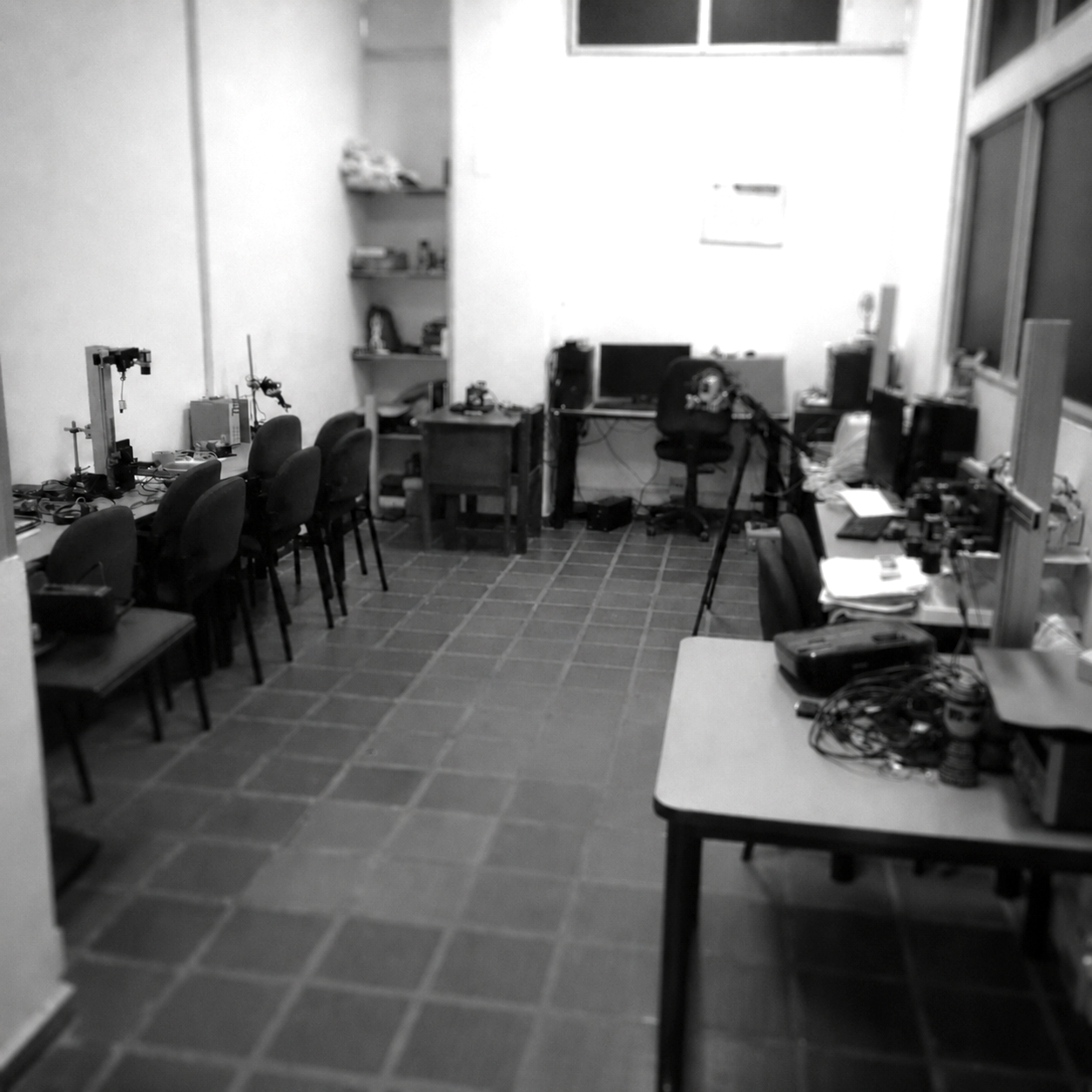
When I returned to Colombia and joined UTB, I was essentially starting from scratch. I had ideas, a few collaborators, and what turned out to be my most important research partnership.
My wife is both my partner in life and my partner in research.
Her background in optics and applied physics complements my own, and together we began looking for problems that were both interesting and within our reach. We had limited funding, modest equipment, and a small team composed mostly of undergraduate engineering students. So we looked for questions that could be tackled with creativity rather than large budgets.
Our experience in optical metrology and computer vision led us to develop machine vision systems and to explore how far we could push the performance of inexpensive equipment. At the same time, we wanted our work to be useful. We soon found that many biomedical applications needed accurate and robust three-dimensional measurements, and that existing solutions often left room for improvement.
That journey led us down a rabbit hole that we are still exploring.
We began revisiting problems that many in the optical metrology community considered solved. What is the best triangulation strategy in a three-dimensional vision system? Is the traditional pinhole model really the best approach for calibration? Are physical calibration targets necessary? Can alternative camera models offer advantages in specific situations?
The deeper we looked, the more questions we found.
Some of that work has been cited. Some of it has inspired follow-up research by other groups. Some of it has found its way into applications we never anticipated when we first began. That is one of the pleasures of research. Once an idea enters the world, it develops a life of its own.
It has been an extraordinary journey.
I do not claim that my research is the best, nor that I have always chosen the most important problems. If anything, Hamming’s question reminds me how difficult it is to know that in advance. Administrative responsibilities now occupy much of my time, and like many academics I often find myself balancing what is urgent against what feels most meaningful.
But when I look back, I feel grateful.
Grateful for the students who joined our laboratory, some of whom I had the privilege of seeing become PhDs themselves. Grateful for the colleagues who became collaborators and friends. Grateful for the opportunity to spend a career asking questions, building things, and occasionally discovering something new.
And perhaps that is my own answer to Hamming.
Not whether every problem I chose was important, but whether I remained curious enough to keep looking for the next one.