There are moments in novels that I remember less for what happened than for what passed between two characters. They stay with me long after other parts of the novel have faded; sometimes even after I have forgotten much of the plot.
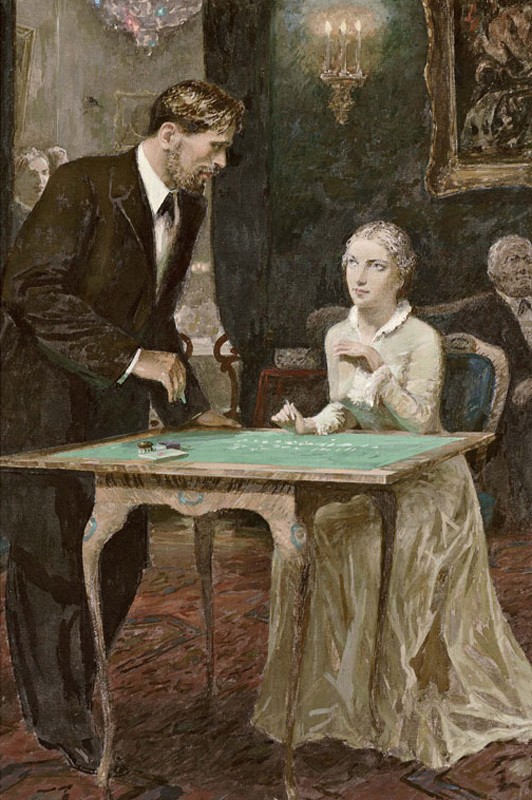
There is a scene in Anna Karenina I have carried with me for years. Nothing much happens. No one dies, no great confession is made. Two people sit at a table and trace a few letters in chalk. Levin and Kitty have already failed once at understanding each other. Between them now lies everything that has happened since: embarrassment, regret, pride, and all those things we don’t manage to say.
Then Levin picks up a piece of chalk. Instead of speaking, he writes the first letters of what he wants to say. And she understands. She answers in the same code. And suddenly, they understand each other.
“I understand,” she said in a whisper.
He sat down and wrote a long phrase. She understood it all […]
For a long while he could not understand what she had written, and often looked into her eyes. He was stupefied with happiness. […] in her charming eyes, beaming with happiness, he saw all he needed to know. […]
She […] wrote the answer, “Yes.”
— Anna Karenina, Leo Tolstoy¹
What moves me there is being understood when words fail. But what happens when “what” cannot be said is terrible?
Then I think of Raskolnikov sitting before Sonya in Crime and Punishment. For most of the novel, he’s lived inside his own arguments. But here, he has to let another person into the darkest room in himself. Sonya senses the truth before he can quite bring himself to say it. And he asks her to look at him. And she does. And still, she doesn’t turn away.
Another dreadful minute passed. They were both still looking at each other.
[…]
With this last, desperate stare she wanted to seek out and catch some last hope for herself, however small. But there was no hope; not the slightest doubt remained.
[…]
“Oh what have you done to yourself?” she said in despair and, leaping to her feet, threw herself on his neck, hugged him and squeezed him tightly-tightly in her arms.
Raskolnikov drew back and looked at her with a sad smile: “You’re a strange one, Sonya – hugging and kissing me when I’ve just told you about that.”
“No, no, nobody in the whole world is unhappier than you are now!”
— Crime and Punishment, Fyodor Dostoyevsky²
And still she does not turn away. But literature, like life, doesn’t always offer that consolation.
There is another scene I carry with me. Stoner and Katherine do not misunderstand each other. Quite the opposite. Yet it has to end. No betrayal, no failure of love, not even a failure to understand each other. Perhaps that is what makes their parting so difficult. They already know what the other is going to say. There is almost nothing left to explain.
The words they said were like a performance of something they had rehearsed again and again in the privacies of their knowledge. They revealed that knowledge by grammatical usage: they progressed from the perfect—“We have been happy, haven’t we?”—to the past—“We were happy—happier than anyone, I think”—and at last came to the necessity of discourse.
[…]
Katherine said, “We don’t have much time, do we?”
“No,” Stoner said quietly.
[…]
“You know if there were anything—anything I could do, I’d—”
“Don’t,” she said. “Of course I know.”
[…]
They said no more. They embraced so that neither might see the other’s face, and made love so that they would not speak. […] Stoner got up quietly, dressed in the dark, and went out of the room without awakening her.
— Stoner, John Williams³
These scenes stay with me the way lived moments do. I know that Levin never picked up that piece of chalk, that Raskolnikov never sat before Sonya, that Stoner never left Katherine sleeping in that darkened room. And yet, somehow, I remember them. I knew them.
That feeling is one of the strange gifts of literature. We carry within us not only the things that have happened to us, but some of the things we have read. Encounters we never witnessed, between people who never existed, become part of the way we understand love, shame, loss, forgiveness, and one another.
Perhaps there is something deeply human in how we carry what moves us into our own memories. Facts fade. We forget what happened, or in what order, or why. But somehow we remember what it felt like.
I have carried these three within me. I suspect I always will.
¹ Leo Tolstoy, Anna Karenina, trans. Constance Garnett (Waxkeep Publishing). Edition on Goodreads.
² Fyodor Dostoyevsky, Crime and Punishment, trans. Oliver Ready (Penguin Classics, 2015). Edition on Goodreads.
³ John Williams, Stoner (New York Review Books Classics, 2006). Edition on Goodreads.